
Are you searching for accurate HSC Chemistry 2nd Paper MCQ Question Solution 2026 (এইচএসসি ২০২৬ রসায়ন ২য় পত্র MCQ প্রশ্ন সমাধান)? This post brings the complete answer key for the 22nd July exam. Students from all education boards, including Dhaka, Rajshahi, Chittagong, Sylhet, and others, can now check the correct answers for every multiple-choice question. HSC Chemistry 2nd Paper Suggestion 2026 PDF, All Board MCQ Solutions, Organic Chemistry MCQ HSC 2026, Electrochemistry Tips HSC.
Our expert team has carefully solved all MCQs from the Chemistry 2nd Paper following the latest HSC 2026 syllabus and NCTB guidelines. Whether you want to verify your answers or calculate your expected marks, this solution guide will help you assess your performance instantly.
HSC Chemistry 2nd Paper MCQ Question Solution 2026
The HSC 2026 examinations are a crucial milestone for Bangladeshi students pursuing higher education in science. Among the key subjects, Chemistry 2nd Paper stands out for its focus on advanced concepts like organic chemistry, electrochemistry, quantitative analysis, and environmental applications. The MCQ section, carrying significant marks, tests conceptual clarity, quick problem-solving, and application skills. This comprehensive 1000+ word guide provides HSC Chemistry 2nd Paper MCQ solutions 2026, expert tips, important topics, and preparation strategies to help you score high.
Why Chemistry 2nd Paper MCQs Matter in HSC 2026
The MCQ portion in HSC Chemistry 2nd Paper typically includes 25-30 questions worth 25-30 marks, emphasizing precision. Questions often come from chapters on organic compounds, reaction mechanisms, electrochemistry, industrial chemistry, and quantitative chemistry. With the updated syllabus, boards emphasize real-world applications, numerical problems, and conceptual twists.
Mastering MCQs can boost your overall grade significantly, as they reward speed and accuracy. Many students lose marks due to tricky distractors or calculation errors. This article compiles high-yield topics, sample solved MCQs (based on board trends and suggestions), and proven techniques for the 2026 exam.
- Check More: HSC Biology 1st Paper MCQ Question Solution 2026
Key Topics for HSC Chemistry 2nd Paper MCQ Question 2026
Focus on these high-weightage areas identified from past papers and final suggestions:
- Organic Chemistry (Hydrocarbons, Functional Groups, Reactions): Electrophilic addition, substitution, isomerism, nomenclature, and mechanisms like SN1/SN2, Markovnikov’s rule.
- Electrochemistry: Redox reactions, electrochemical cells, Nernst equation, Faraday’s laws, conductivity.
- Quantitative Chemistry: Stoichiometry, mole concepts, limiting reagents, titration calculations.
- Industrial & Environmental Chemistry: Haber process, contact process, pollution control, green chemistry.
- Physical Chemistry Aspects: Thermodynamics (enthalpy, entropy), chemical kinetics, equilibrium (Le Chatelier’s principle).
- Inorganic Extensions: Coordination compounds, transition metals, qualitative analysis.
Prioritize board questions from recent years, as patterns repeat with variations.
Sample MCQ Solutions with Explanations (2026 Trend-Based)
Here are representative MCQs with detailed solutions to build your understanding. Practice similar ones from reliable suggestion PDFs.
এইচএসসি ২০২৬ রসায়ন ২য় পত্র MCQ প্রশ্ন সমাধান


HSC 2026 Chemistry 2nd Paper MCQ Answer (for Irregular 2025) অনিয়মিত
.jpg)
.jpg)
HSC Chemistry 2nd Paper Question 2026
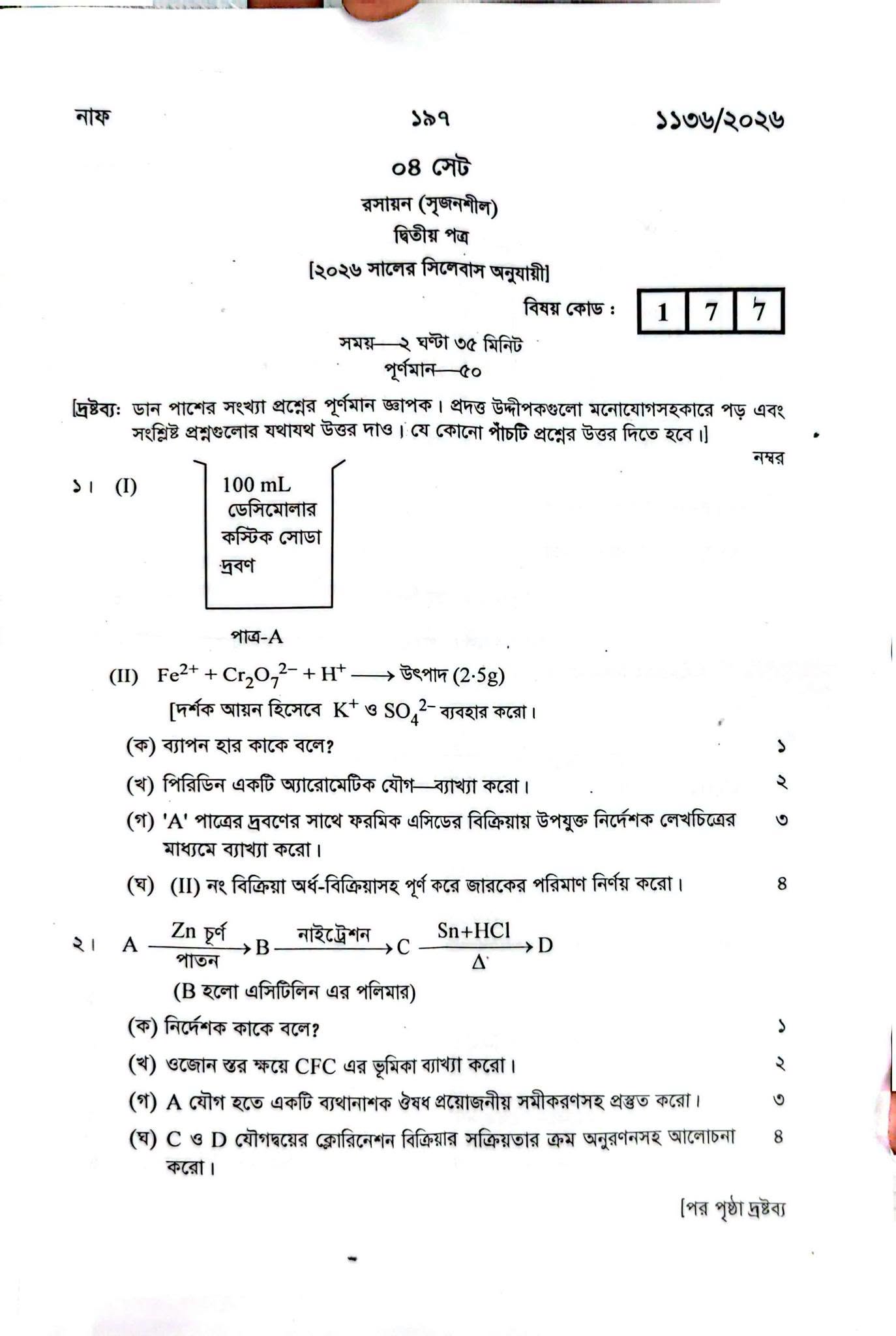


Example 1: Organic Reaction Mechanism Question: Which of the following is the major product when propene reacts with HBr in the presence of peroxide? (a) 1-Bromopropane (b) 2-Bromopropane (c) 1,2-Dibromopropane (d) Propane
Solution: (a) 1-Bromopropane. Explanation: In the presence of peroxide, the reaction follows anti-Markovnikov addition via a free radical mechanism. Br adds to the less substituted carbon. This is a classic question testing an exception to Markovnikov’s rule. Memorize conditions for ionic vs. radical pathways.
Example 2: Electrochemistry Question: The standard electrode potential for a cell is +0.34 V. If the concentration of Cu²⁺ is increased, the cell potential will: (a) Increase (b) Decrease (c) Remain the same (d) Become zero
Solution: (a) Increase. Explanation: According to the Nernst equation, E = E° – (RT/nF) ln Q. Increasing [Cu²⁺] decreases Q for the reduction half-cell, increasing E. Practice numericals involving concentration effects.
Example 3: Quantitative Analysis Question: In the titration of NaOH with HCl, the indicator used for strong acid-strong base is: (a) Phenolphthalein (b) Methyl orange (c) Litmus (d) All of the above
Solution: (b) Methyl orange (or phenolphthalein works too, but commonly methyl orange for precision in many contexts; check exact options). Explanation: For strong acid-strong base, phenolphthalein (color change 8.2-10) or methyl orange (3.1-4.4) both work, but questions often specify equivalence point pH ~7. Understand pH ranges deeply.
Example 4: Environmental Chemistry Question: The primary pollutant responsible for acid rain is: (a) CO₂ (b) SO₂ (c) N₂ (d) O₃
Solution: (b) SO₂. Explanation: SO₂ and NOx form H₂SO₄ and HNO₃ in the atmosphere. Link this to industrial processes like the contact process.
Work through 50-100 such MCQs daily from chapter-wise banks and previous board papers.
Expert Preparation Tips for HSC 2026 Chemistry 2nd Paper MCQs
- Time Management: Allocate 30-40 seconds per MCQ. Practice full sets in timed conditions.
- Elimination Technique: Rule out obviously wrong options first. Look for units, signs, or exceptions.
- Conceptual Clarity Over Rote Learning: Understand “why” behind reactions. Draw mechanisms repeatedly.
- Numerical Proficiency: Master mole calculations, Faraday’s constant (96500 C/mol), gas laws, and equilibrium constants.
- Common Pitfalls: Confusing cis-trans isomers, oxidation states in redox, or sign conventions in electrochemistry.
- Daily Routine: Solve 1-2 full MCQ tests. Revise wrong answers in a notebook. Use mnemonics for organic name reactions (e.g., Grignard, Aldol).
- Resources: Refer to NCTB textbooks, final suggestions from trusted platforms, YouTube sure-shot classes, and chapter-wise MCQ PDFs. Join active Facebook groups for discussions.
- Revision Strategy: Last 7-10 days: Focus on high-yield MCQs, a formula sheet, and quick recalls. Avoid new topics.
Chapter-wise Weightage & Strategy (Approximate)
- Organic Chemistry: 30-40% — Heavy on reactions and identification.
- Electrochemistry & Quantitative: 25-30% — Calculation-heavy.
- Others: Balance with environmental and industrial topics for easy marks.
Analyze all-board questions from 2023-2025 to spot repeats. Many 2026 suggestions highlight “sure-shot” topics like aluminum compounds, Lewis acids, carbocations, and electrochemical series.
Post-Exam: Checking Solutions & Result Prediction
After the exam, compare your answers with official or reliable coaching solutions (e.g., from Udvash, Xenon Academy, or education blogs). This helps in estimating GPA. For 2026, expect solutions to appear quickly on YouTube and educational sites.
Additional Benefits of Strong MCQ Performance
Scoring 20+ in MCQs leaves room for creative (CQ) sections. It builds confidence and reduces stress. Consistent practice also aids university admission tests like BUET or medical entrances, where chemistry MCQs are common.
Final Words
Success in HSC Chemistry 2nd Paper MCQ requires smart work: targeted practice, error analysis, and staying updated with board trends. This guide serves as your one-stop resource for HSC Chemistry 2nd Paper MCQ Question Solution 2026, covering solutions, tips, and strategies. Download suggested PDFs, watch revision classes, and maintain a positive mindset.
Stay consistent, revise daily, and you will excel. Best wishes to all HSC 2026 candidates! Share this article with fellow students and bookmark it for quick reference.
1 thought on “HSC Chemistry 2nd Paper MCQ Question Solution 2026”