
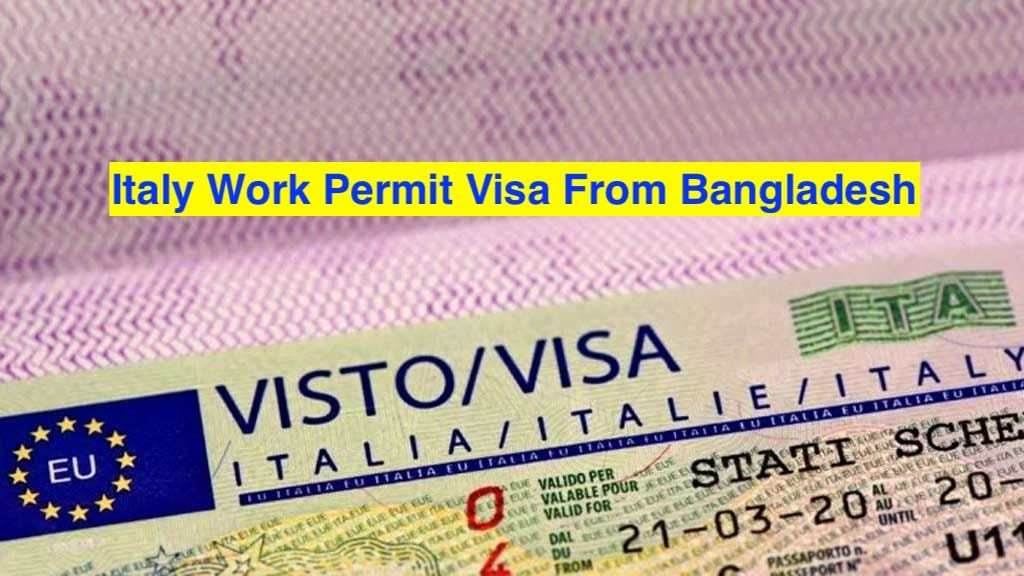
Italy Work Permit Visa 2026 – How to apply for Decreto Flussi. Italy remains an attractive destination for non-EU workers seeking employment in Europe. In 2026, Italy is continuing its Decreto Flussi system, which regulates the number of non-EU nationals who can enter the country for employment. The 2026–2028 program provides 497,550 total legal work-entry quotas, including 164,850 places for 2026. Italy Work Visa for Bangladesh, India, Pakistan, Singapore, Oman, Saudi Arabia, Qatar. Italy Click Day 2027.
Italy Work Permit Visa 2026 – How to apply for Decreto Flussi
For applicants outside the European Union, obtaining an Italian work visa generally involves two major stages: the Italian employer obtains a work authorization (nulla osta), and then the worker applies for an Italian national work visa at the Italian consulate or authorized visa application center in their country of residence.
What Is the Italy Work Permit Visa?
The Italy work permit process allows eligible non-EU citizens to enter Italy and legally work for an Italian employer.
There are several categories, including:
- Non-seasonal employed work
- Seasonal agricultural work
- Seasonal tourism work
- Highly skilled employment, including the EU Blue Card route
- Self-employment
- Certain special categories of workers
The Decreto Flussi is particularly important for ordinary employment and seasonal workers because many applications are subject to government-set quotas.
Italy Work Visa Quotas 2026
Under Italy’s three-year immigration program for 2026–2028, the government established:
| Year | Total quota |
|---|---|
| 2026 | 164,850 |
| 2027 | 165,850 |
| 2028 | 166,850 |
| Total | 497,550 |
These quotas cover subordinate employment, seasonal employment and self-employment, as well as certain conversions of existing residence permits.
For 2026, the quota was divided among different categories and sectors, including non-seasonal employment, agriculture, tourism and other eligible employment routes. The Italian Ministry of Labour subsequently published additional territorial allocations during 2026.
Who Can Apply?
A non-EU citizen generally needs:
- A genuine job offer from an Italian employer.
- An employer willing and legally able to sponsor the employment.
- A nulla osta al lavoro (work authorization) where required.
- A valid passport.
- The appropriate Italian national visa.
- Supporting documents required by the Italian consulate/visa center.
- Compliance with Italian immigration requirements.
Importantly, applicants normally cannot simply apply for a standard work visa without an Italian employer. For ordinary subordinate employment, the employer initiates the work-authorization procedure with the Sportello Unico per l’Immigrazione.
Announcement of 166,000 Worker Recruitment in Italy: How to Apply
Italy is opening its labor market to foreign workers on a large scale. Under the country’s ‘Decreto Flussi’ (Flow Decree) program for the 2026–2028 period, a total of 165,850 foreign workers will be recruited in 2027. Opportunities exist across three categories: seasonal, non-seasonal, and self-employment.
According to official Italian data, the 2027 quota allocates 76,200 spots for non-seasonal jobs, 89,000 for seasonal work in agriculture and tourism, and 650 for self-employment. Within the non-seasonal quota, 14,000 spots are reserved for family-based caregiving roles. Bangladesh is included in the list of eligible countries for this recruitment drive. The official list reserves quotas for citizens of several nations, including Bangladesh, India, Pakistan, Sri Lanka, the Philippines, Nepal, and various African countries.
How to Apply
Pre-filling (or ‘pre-compilation’) of applications for the 2027 quota begins on October 23, 2026, at 9:00 AM and continues until December 7, 2026, at 8:00 PM. Applications must be submitted via the Italian Ministry of the Interior’s ‘Portale Servizi ALI’ platform.
However, foreign workers generally do not apply for this quota directly themselves. An employer or authorized representative based in Italy submits the application requesting work authorization—known as *nulla osta*—on behalf of the worker. Once the authorization is granted, the worker completes the work visa process through the Italian embassy or consulate in their home country.
The ‘Click Day’ (submission date) for 2027 has been scheduled separately for each sector. Application submissions will begin on January 12, 2027, for seasonal agricultural workers; February 9 for the tourism sector; February 16 for non-seasonal work; and February 18 for the family-based caregiving sector. In each instance, the application process will commence at 9:00 AM (Italian local time). Applications may be submitted until December 31, 2027, subject to quota availability.
Italy plans to recruit a total of 497,550 foreign workers over the three-year period from 2026 to 2028. The quotas set are 164,850 for 2026, 165,850 for 2027, and 166,850 for 2028. It is crucial for workers to note that the application process proceeds solely through legitimate employers and official government channels. Therefore, before paying any money to an individual or broker for a job or visa, it is essential to verify the authenticity of the job offer, the employer, and the *nulla osta* (work authorization).
- Application starts on 23rd October 2026
- Deadline: 7th December 2026
- Visit the website: Log in to the official Italian immigration website at https://portaleservizi.dlci.interno.it
- 2. Register: If you are a new user, please register.
- 3. Fill out the form: Go to the “Flussi Decree” tab and fill out the prescribed form.
- 4. Attach documents: Upload the necessary documents, such as your passport, employment contract, etc.
- 5. Submit: After submitting the application, be prepared for “Click Day.”
Click Day: The dates for “Click Day” in 2027 are 12th January and 9th, 16th, and 18th February. You must complete the application quickly on these days.
How the Italy Work Permit Process Works
Step 1: Find an Italian Employer
The first major step is securing a legitimate job offer from an Italian company or employer.
The employer must be prepared to employ a non-EU worker and complete the required immigration procedure.
Be particularly careful with people or agencies promising an Italian work visa without a genuine employer. A job offer alone does not guarantee visa approval.
Step 2: Employer Applies for the Nulla Osta
The Italian employer submits the application for work authorization through the appropriate government procedure.
The Sportello Unico per l’Immigrazione (SUI) handles work-authorization procedures for eligible foreign workers. The SUI operates through the prefectures and, where applicable, coordinates the necessary checks with other authorities. For workers entering through the Decreto Flussi system, the application must fit within the applicable quota.
Step 3: Nulla Osta Is Issued
If the application satisfies the requirements and a quota is available, the authorities can issue the nulla osta.
The applicant can then proceed with the visa application according to the instructions of the Italian diplomatic mission responsible for their place of residence.
Step 4: Apply for the Italian Work Visa
The worker submits the required visa application and supporting documents.
Italy’s Ministry of Foreign Affairs distinguishes several employment visa categories, including subordinate employment, seasonal work, self-employment, and the EU Blue Card route.
The exact document list can vary according to the visa category and the applicant’s country.
Step 5: Travel to Italy
Once the visa is granted, the applicant can travel to Italy during the visa’s validity period.
However, the visa is not the end of the immigration process.
Step 6: Apply for the Permesso di Soggiorno
After entering Italy, the foreign worker must complete the residence-permit procedure.
Italy’s Ministry of the Interior states that a residence permit must generally be requested within 8 working days of entry for the relevant long-stay circumstances.
The residence permit, or permesso di soggiorno, is what allows the foreign national to lawfully remain in Italy for the purpose for which it was issued.
Italy Work Visa Requirements
The precise requirements depend on the applicant’s nationality and visa category, but commonly requested documents can include:
- Valid passport
- Completed visa application form
- Passport photographs
- Nulla osta/work authorization
- Employment-related documentation
- Proof of accommodation or other required documentation
- Civil-status documents where applicable
- Documents demonstrating compliance with consular requirements
- Visa fee
- Additional documents requested by the Italian consulate or visa center
Applicants should always check the current checklist issued by the Italian diplomatic mission responsible for their application rather than relying on an old checklist.
Italy Work Visa From Bangladesh
For Bangladeshi applicants, the Embassy of Italy in Dhaka provides specific information about visa procedures.
As of the Embassy’s July 2026 update, Italy visa applications in Bangladesh are submitted through the designated VFS Global Italy Visa and Legalization Application Centres. The Embassy lists centers in Dhaka, Chattogram, and Sylhet.
The Embassy also has a specific procedure for applicants covered by the Decreto Flussi. According to its current guidance, applicants with a valid nulla osta issued after 22 October 2024 can begin the work-visa application process through the designated webform system.
Another important requirement is that Italian employers may have to confirm the job offer during the visa process. The Embassy notes that, following Italian Law Decree 145/2024, the SUI requests confirmation from the employer, and the employer must provide it within the prescribed period.
How Long Is an Italian Work Residence Permit Valid?
The validity depends on the type of employment.
According to the Italian Ministry of the Interior:
- Seasonal work: up to 9 months
- Fixed-term employment: generally linked to the employment arrangement and applicable immigration rules
- Permanent subordinate employment: residence permit can be issued for up to 2 years
- Self-employment: residence permit can be issued for up to 2 years
The applicable duration can depend on the specific visa and employment circumstances.
Can You Change or Renew an Italian Work Permit?
Yes, under applicable conditions.
A residence permit can potentially be renewed if the worker continues to satisfy the relevant requirements. The Ministry of the Interior states that renewal should generally be requested at least 60 days before expiry.
Certain residence permits can also be converted into employment permits, subject to the applicable requirements and available quotas.
For example, some study or training permits can be converted into permits for subordinate or self-employed work.
Important 2026–2027 Update
Although this article focuses on 2026, applicants should be aware that Italy’s 2026–2028 immigration program is already moving into its next annual phase.
On 1 October 2026, the Italian Ministry of Labour published operational instructions for the 2027 Decreto Flussi. The 2027 program provides:
- 76,200 non-seasonal subordinate employment places
- 89,000 seasonal employment places
- 650 self-employment places
Pre-compilation of applications is scheduled for 23 October–7 December 2026, with the relevant 2027 click days scheduled in January and February 2027.
This is important for people who are preparing now but may not obtain a 2026 quota.
Common Reasons for Problems or Delays
Applicants should be especially careful about:
- Fake job offers
- Fake nulla osta documents
- Employers who do not actually intend to employ the applicant
- Incorrect or inconsistent information in applications
- Missing documents
- Expired passports or documents
- Problems confirming the employment relationship
- Applying under the wrong visa category
- Using unofficial agents who promise guaranteed visas
No legitimate agent can guarantee an Italian work visa. The final decision is made by the competent Italian authorities.
Italy Work Permit Visa 2026: Key Takeaways
The Italian work visa system is based heavily on the relationship between the employer, work authorization, visa, and residence permit.
The basic pathway is:
Job offer → Employer’s nulla osta application → Nulla osta → Italian work visa → Entry into Italy → Permesso di soggiorno → Legal employment
For 2026, Italy has a substantial quota of 164,850 work-related entries, while the wider 2026–2028 program provides 497,550 places.
Applicants should use official Italian government and diplomatic sources for the latest requirements because quotas, application procedures, document checklists, and appointment arrangements can change.